


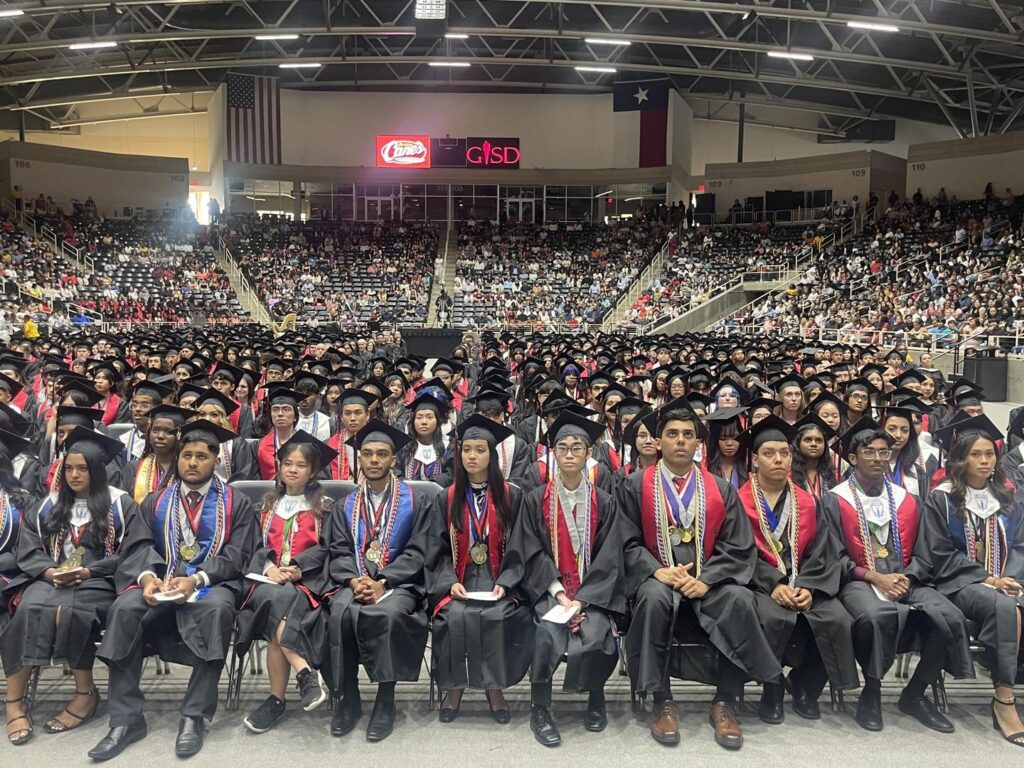
How Garland ISD Is Leading Dallas County in College Readiness
By the Economic Mobility Center | Dallas County Promise
Building on its landmark College for All model, Garland ISD is now showing what it looks like when a district goes all the way — connecting every student, on every pathway, to credentials that translate into economic mobility.When Every Senior Stands
At Garland ISD graduations, Superintendent Dr. Ricardo López has a tradition. He asks students to stand — if they’ve met college readiness standards, if they’ve earned dual credit hours, if they’ve already completed an associate degree. And then almost the entire senior class rises.“You see the amount of kids impacted and the pride on their faces and the confidence that they have when they’re walking across that stage. That’s what makes this so special.” – Dr. Jason Adams, Chief Academic Officer, Garland ISDThat scene is the product of nearly a decade of deliberate, disciplined work — and it’s producing numbers that are turning heads across Texas and beyond. Roughly 15% of the Class of 2025 graduated with an associate degree alongside their high school diploma, a figure that ranks among the highest in Texas for large urban school districts. And roughly 60% of graduating seniors completed a Career and Technical Education (CTE) pathway, with approximately 6,500 certifications expected district-wide. But what’s happening in Garland today is no longer just a college access story. It’s a living wage story. And district leaders believe it’s a blueprint worth replicating.
Leadership Before Partnership
Eight years ago, Garland ISD made a decision: every student deserved more than a diploma. They deserved a clear, proven pathway to a high-wage career, college success, and a life of opportunity.“What you’re seeing in our outcomes today reflects a community committed to that vision and unwilling to settle for less. When schools, colleges, and community partners align around students, results follow. This isn’t just a Garland story, it’s a model.” – Dr. Ricardo López, Superintendent, Garland ISDThat clarity of purpose — stated plainly enough that no one inside the organization can mistake it for something softer — is what enabled everything that followed. And it reflects the kind of leadership the Dallas County Economic Mobility Model requires as a precondition. The four-partner model doesn’t activate in a vacuum. It requires specific district leadership already in place before the partnerships can produce results. For districts considering this work, that leadership is not a parallel track. It is the pre-condition.
- Clear Vision District leadership must articulate, at the superintendent level, a genuine commitment to economic mobility for every student — not as a compliance goal, but as a moral one. In Garland, Dr. López named what students deserved, not just what the district was required to deliver. Everything else — scheduling decisions, budget allocations, partner relationships, staff culture — flows from whether that commitment is real.
- Vertical Leadership Alignment Vision set at the top only produces results when it is owned at every level below it. Campus principals, counselors, CTE directors, teaching and learning teams, and external partners all need to understand their specific role in the same shared goal. “Everybody knows what their role is, everybody knows what piece they own and the part they play in the overall plan,” says Dr. Adams. “And now it’s kind of just running.”
- Leveraging Data and Holding Everyone Accountable The model runs on data — but only if leadership builds the structures to make data actionable rather than merely reportable. That means regular review cadences, shared dashboards, and a culture in which the numbers drive decisions rather than confirm them.
- Engaging Students and Families as True Partners The model reaches its full potential only when students and families are active participants in the work — not recipients of services, but genuine stakeholders who understand the opportunity in front of them and are equipped to pursue it.
The Economic Mobility Partnership Model
Garland’s results don’t emerge from a single program or a single relationship. They are the product of four aligned bets — each targeting a different leverage point in the pipeline from enrollment to economic mobility.Pre-Condition: Strong District Leadership
Dr. Ricardo López anchored the work in a clear theory of change: economic mobility for every student, on every pathway. He set the vision at the district’s highest level; Dr. Jason Adams built the cross-departmental infrastructure to make it operational. Together they created the conditions — shared ownership, aligned goals, and data-driven accountability — that allowed all four partners to do their best work. That foundation is what makes the model run.Partner 1
Dallas County Promise — Student & Family Engagement
The Dallas County Promise Campaign anchors the student and family engagement side of the model. In a district of more than 50,000 students across seven comprehensive high schools, the Promise Campaign ensures families understand what’s available — removing informational barriers, building college-going culture that reaches all the way down to elementary school, and making sure no student misses an opportunity because they didn’t know it existed. Sustained outreach is what makes Garland’s College for All model visible to every family, not just the ones already plugged in.Partner 2
Education is Freedom — Career & College Advising
Education is Freedom provides embedded career and college advisors in all of Garland’s high schools, weaving postsecondary planning into the daily fabric of each campus. Advisors help students navigate their full range of options — whether that’s a four-year university, an associate degree earned alongside the diploma, or a direct path into an industry certification and a career. By operating inside every campus, Education is Freedom ensures that every student graduates with a clear plan for what comes next.“Education is Freedom strengthens the incredible work of our school counselors by providing personalized college and career guidance, clear pathways to postsecondary options, and timely support for students and families. Together, this partnership ensures our seniors have the direction, resources, and confidence they need to successfully transition to their future.” – Dr. Tiffany Gilmore, Executive Director of Guidance and Counseling, Garland ISD
Partner 3
Economic Mobility Center — Leadership & Data Services Support
The Economic Mobility Center — a collaboration between Dallas College and the Commit Partnership — provides the regional coordination, leadership infrastructure, and data tools that allow all the pieces to work together. The EMC’s data capabilities give Garland leaders the ability to surface the right information at the right moment, making it possible to move faster, adapt more confidently, and communicate outcomes with precision to all stakeholders.“With Eric’s work with EMC, the way that we’re able to pull that and drill down to make data actionable pretty quickly, it’s really been important for us.” – Dr. Jason Adams, Chief Academic Officer, Garland ISD
Partner 4
Dallas College — College & Workforce Programs
Dallas College provides the postsecondary programming infrastructure that makes early college and P-TECH possible at scale — including free tuition for dual credit students and dedicated success coaches embedded in the work. In 2024–25, Garland students earned more than 59,000 college credit hours through this partnership, saving families an estimated $3.9 million in college costs. Dallas College’s partnership also extends through CTE expansion to students whose plan runs through workforce rather than a four-year university — including a major renovation of the Gilbert Reed Career, Technology & Innovation Center, adding programs in diesel mechanics and land surveying.“The superpower between all of this is: here we have a goal, we have an objective that we’re all working towards — and also having regular checkpoints to come together, share and exchange, and never lose sight of where the goal is.” – Dr. Jason Adams, Chief Academic Officer, Garland ISD
The Numbers Tell the Story
The results for the Class of 2025 are striking. According to Dallas County Promise data tracking Garland ISD’s HB3 performance:| Metric | Result | Context |
|---|---|---|
| TSI College Readiness | 33% (2024) → 41% (2025) | 8-point gain — ~400 more students college-ready |
| Associate Degrees at Graduation | ~15% of Class of 2025 | Among highest rates in Texas for large urban districts |
| CTE Pathway Completion | 60%+ of graduating seniors | ~6,500 certifications district-wide |
| College Credit Hours Earned | 59,000+ in 2024–25 | $3.9M in college savings for families |
| HB3 Outcomes-Based Funding | $2.7M (2024) → $4.2M (2025) | 55%+ increase — top 10 in Texas |
The Question for the Region
Garland is already preparing for the 2031 CCMR changes by aggressively pursuing TSI-by-exam rates, with a goal of exceeding 60% of students TSI-met by exam by 2030. Because the systems are already running, the district can adapt more quickly than those still building their infrastructure.“I’m excited about kids walking out of our door, going directly into a career, making a livable wage. I can go earn six figures a year starting at 18, 19 years old and have a good career that can continue to grow from there.” – Dr. Jason Adams, Chief Academic Officer, Garland ISDThe vision is ambitious. The systems are in place. The data is compelling. And at graduation, when almost an entire senior class stands — because they’ve earned something real, something the system can’t take away — it’s hard to argue with the evidence. What Garland has built is not a pilot. It is not a demonstration project. It is a fully operational, sustainable, and academically rigorous model producing meaningful economic outcomes at scale. The question the district’s leaders are quietly asking is: who else is willing to do this?
The foundation has been built. The culture has shifted. The data is moving. And it is the options and success of each individual Garland student — ready and supported post-graduation — that makes this progress truly rewarding. What Garland has built is a model. The question is who else is willing to do this.
About this Work
Garland ISD’s postsecondary results are tracked through the Dallas County Promise HB3 dashboard, supported by Economic Mobility Center data and analytics services. The four-strategy partnership model — Dallas County Promise, Education is Freedom, Economic Mobility Center, and Dallas College — is designed to be replicable across Dallas County school districts.
A Legacy Built on Data, Teamwork, and High Expectations
How DeSoto ISD Is Leading Dallas County in College Readiness