


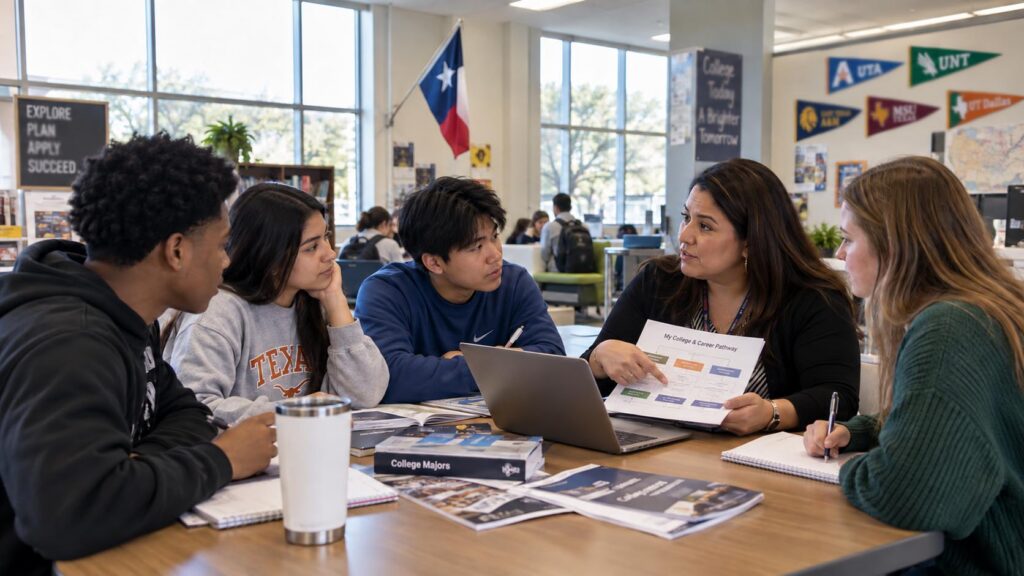
That is the EMC difference. EMC brings school districts, community colleges, and regional partners together so students can move from high school into college, a credential of value, and a good job without falling through the gaps in between. The dollars are not the outcome. Better student outcomes, sustained over time, are.
A Shared Framework for Student Success
Texas has aligned important incentives across K-12 and higher education. HB 3 rewards qualifying college, career, and military readiness outcomes, including $5,000 per qualifying economically disadvantaged graduate above the applicable threshold (Texas Education Agency, 2026). HB 8 rewards community college outcomes including credentials of value, qualifying transfer, and 15 semester credit hours of dual credit (Texas Higher Education Coordinating Board). SB 788 of 2021 directed state agencies to develop model data-sharing agreements (Texas Legislature, 2021). Together, these policies give regions a stronger framework for improving shared student outcomes.
A single district can act on that framework, but it can only see part of the picture. A student who earns dual credit in high school is building toward a CCMR outcome and a community college outcome at the same time. When districts and colleges plan together, both can see that student’s full path and act on it.
EMC’s role is to make that regional work practical. EMC helps partners build the data infrastructure, timely and actionable data, continuous student records, tools, and regional coordination that practitioners need to identify gaps, intervene earlier, and improve student outcomes. The goal is not another dashboard. It is one shared view of student progress that districts and colleges use together.
What This Looks Like in Practice
Districts across Texas are showing what is possible when readiness becomes a shared, year-round priority.
Garland ISD has become a regional leader in CCMR readiness: its cross-divisional CCMR team helped the district reach 93% CCMR-readiness, meaning nearly every graduating senior left high school with a documented plan for college, a career, or the military (Commit Partnership, 2024).
DeSoto ISD has shown similar momentum on the college-readiness side, improving its Texas Success Initiative (TSI) Met by Assessment rate from 27% to 42% for the Class of 2025 (DeSoto ISD, 2026). For DeSoto students, that progress means more graduates entering college ready for credit-bearing coursework from their first semester.
Many districts are still building the systems needed to help every student reach that level of readiness. That work is less about funding and more about practice, and it is where EMC focuses its support.
What the CCMR Bonus Requires
CCMR outcomes funding is not automatic. Districts must meet specific requirements, including annual reporting from a qualified coordinator, quantifiable five-year goals for each school, and an annual review by the board at a public meeting.
Districts must also adopt CCMR plans with annual goals for aggregate student growth, including targets for specific student groups. Meeting those goals, and reporting on them accurately, requires clear and reliable data on readiness indicators such as college credit hours, industry certifications, and military-readiness qualifications, tracked and verified throughout the year. For many campuses, that is a significant lift without dedicated support.
How This Helps Students and Practitioners
For counselors, teachers, and campus leaders, CCMR is a signal of whether more students are leaving high school with a real plan and the readiness to carry it out. Meeting CCMR criteria means a student earned college credit, an industry certification, or qualified for military service.
For students, that translates into real differences: fewer arriving at college needing remedial coursework, more entering the workforce with a credential employers recognize, and a clearer, earlier path from K-12 into whatever comes after graduation.
Turning Policy into Practice
The opportunity is not simply for districts to capture more funding. It is to build the capacity and systems needed to turn that funding into meaningful improvements for students. Districts seeing the strongest CCMR results share a common practice: they track campus-level goals throughout the year rather than relying on a single annual snapshot. That real-time view gives practitioners the chance to spot which students need support while there is still time to act.
Districts can build on this approach through a few key practices:
- Developing real-time CCMR tracking that functions throughout the year, rather than relying on year-end reports.
- Aligning board goals with campus-level data reviews.
- Connecting high school readiness data with college partners, so dual credit, transfer, and credential outcomes are visible across the full pathway.
Partnering with EMC can help more students reach CCMR readiness and build the systems that carry them from K-12 into college, a career, or the military. Policy creates the opportunity. Funding provides resources. EMC helps partners build the infrastructure and practices that turn both into better student outcomes. Learn more about EMC, including the benefits of becoming a partner, and reach out to us through our contact form to start a discussion.
Sources
- Commit Partnership. “Garland ISD Receives Inaugural Economic Mobility Award from the Commit Partnership.” 2024.
- DeSoto ISD. “DeSoto ISD and DeSoto High School Recognized with Dallas County Promise Economic Mobility Awards.” 2026.
- Texas Education Agency. “CCMR in Accountability vs. Outcomes Bonus: 2026 Guide.”
- Texas Higher Education Coordinating Board. “Community College Finance.”
- Texas Legislature. Senate Bill 788, 87th Regular Session. 2021.